
Standing on the porch with a tape measure in one hand and a phone full of half-saved Pinterest pins in the other has become a familiar summer 2026 ritual for American homeowners. With the July 4th cookout weekend just around the corner, Memorial Day already in the rearview, and peak home-improvement season pushing into late June, the front door wall sconce has quietly become the most-shopped exterior fixture of the season. Specifically, the modern 13W 3000K aluminum LED wall sconce — the kind that throws a clean up-and-down beam onto siding without the harsh blue tint of a cheap big-box pick.
If you have ever stood in front of a 200-fixture lighting aisle and felt your eyes glaze over, this guide is for you. Below is the 9-point buyer’s checklist American homeowners are using right now to choose a modern outdoor wall sconce that actually fits their summer 2026 entertaining season — without overpaying, over-spec’ing, or ending up with a fixture that looks great on the website and wrong in person. We’ll walk through the wattage, color temperature, IP rating, mounting plate, finish, dimensions, install timeline, lifespan math, and budget logic that separate a smart buy from a regret. Bring a coffee. This is the checklist you’ll wish you had bookmarked before your last front-door upgrade.
1. Start with Wattage: Why 13W Hits the American Front-Door Sweet Spot
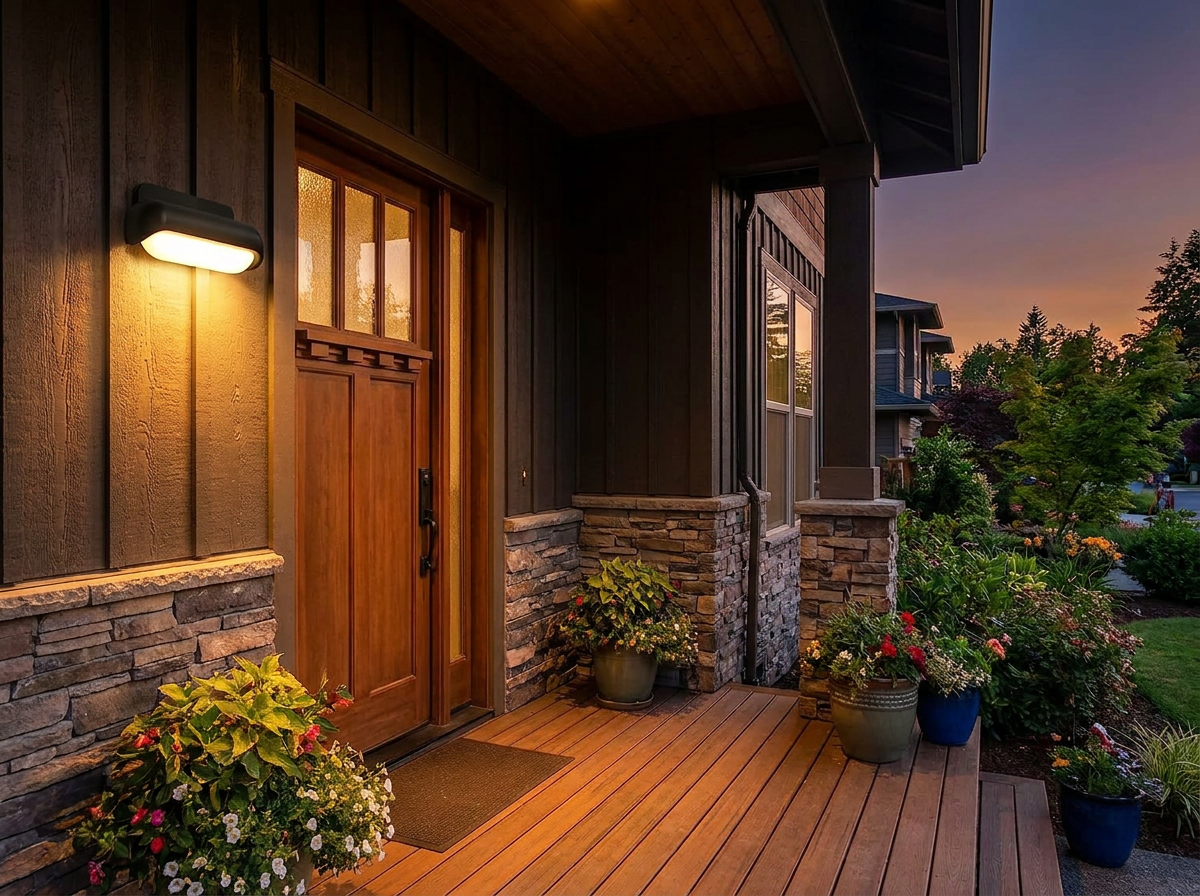
Wattage is the first number to lock in, because everything else — brightness, heat, dimmer compatibility, even fixture size — flows from it. For a standard American front door (call it 36 inches wide, with porch ceiling around 8 to 9 feet), 13W of LED is the new sweet spot for summer 2026. It’s bright enough to read the package label on a delivery box at 9 PM, soft enough not to wash out a freshly painted door, and small enough that the fixture itself stays slim and modern rather than looking like a security floodlight bolted to the siding. If you go below 10W, your porch will feel underlit by Independence Day weekend; push above 20W on a single front-door fixture and the up-and-down beam can hot-spot the soffit. 13W is the buying-guide answer most US lighting designers quietly recommend in 2026 when a homeowner asks for “modern but not blinding.”
2. Color Temperature: Lock in 3000K, Skip 5000K, Avoid Color-Switching Gimmicks
If wattage is the first checkbox, color temperature is the second — and it’s where most American buyers slip. 3000K is warm white. It’s the color of a softly glowing candle filament, the lighting in a nice steakhouse, the tone that makes red brick look red and warm-tone vinyl siding look inviting rather than sterile. 5000K is daylight cool — fine for a garage workshop, wrong for a summer front porch where you’re greeting neighbors during the July 4th block party. Color-switching wall sconces (2700K/3000K/5000K toggle) sound flexible on the box, but in practice almost every American homeowner picks 3000K once and never touches the switch again. Save the money, lock in 3000K, and you’re done. The PLUSLED Modern Wall Sconce 13W 3000K is purpose-built for exactly this — a fixed warm tone that flatters cedar, brick, vinyl, fiber cement, and stucco without a learning curve.
3. IP Rating: The Two Letters That Survive an American Summer Storm
American summer 2026 is shaping up to be a wet one, with NOAA outlooks calling for above-average thunderstorm activity across the Midwest, Southeast, and Mid-Atlantic into Labor Day. That means a porch sconce facing the wrong direction is going to get hit with sideways rain at least a dozen times before football season starts. Look for an IP rating that’s at least IP44, with IP65 being the gold standard for sconces mounted in unprotected wall locations. The aluminum housing on a quality modern wall sconce, paired with a properly gasketed lens, is what stands between your fixture and a corroded LED driver in October. If a product page doesn’t clearly state the IP rating, treat that as a red flag and move on. American building codes increasingly expect this number on the receipt.
4. Mounting Plate Compatibility: The 5-Minute Check Most Buyers Forget
Before you click buy, walk to your front door and look at the existing fixture. If it’s currently mounted on a standard 4-inch round US junction box (almost everything built since 1990 is), confirm the new sconce’s mounting plate has the same slot pattern. The Modern Wall Sconce we’re discussing here ships with a universal US mounting plate that fits the standard 4-inch round and 4-inch square junction boxes used in roughly 95% of American homes — so most porches are a direct swap with no extra trip to Home Depot. Older homes with shallower boxes or surface-mount conduit may need an extension ring; a quick photo sent to your electrician answers it in five minutes. This is the boring step that turns a Saturday install into a 90-minute project instead of a half-day headache.
5. Finish: Why Matte Black Is Outpacing Bronze for Summer 2026
Drive through any newer American suburb in June 2026 — Frisco, Tampa, Charlotte, Boise — and you’ll see the trend: matte black has become the default exterior finish on new builds and front-door refreshes alike. Oil-rubbed bronze still has a strong place on traditional Craftsman and Colonial homes, but for modern, transitional, and modern-farmhouse exteriors, matte black is winning the 2026 summer selling season. The reason is mostly visual: matte black holds a clean silhouette against any siding color, hides bug debris between cleanings, and pairs cleanly with the matte-black hardware most American homeowners already chose for their door knobs, house numbers, and mailbox. If your front door, garage door, and house numbers are already black, matching the wall sconce closes the loop and reads as intentional design rather than mismatch.
6. Dimensions: Why “Eye-Level Plus 6 Inches” Beats Guesswork
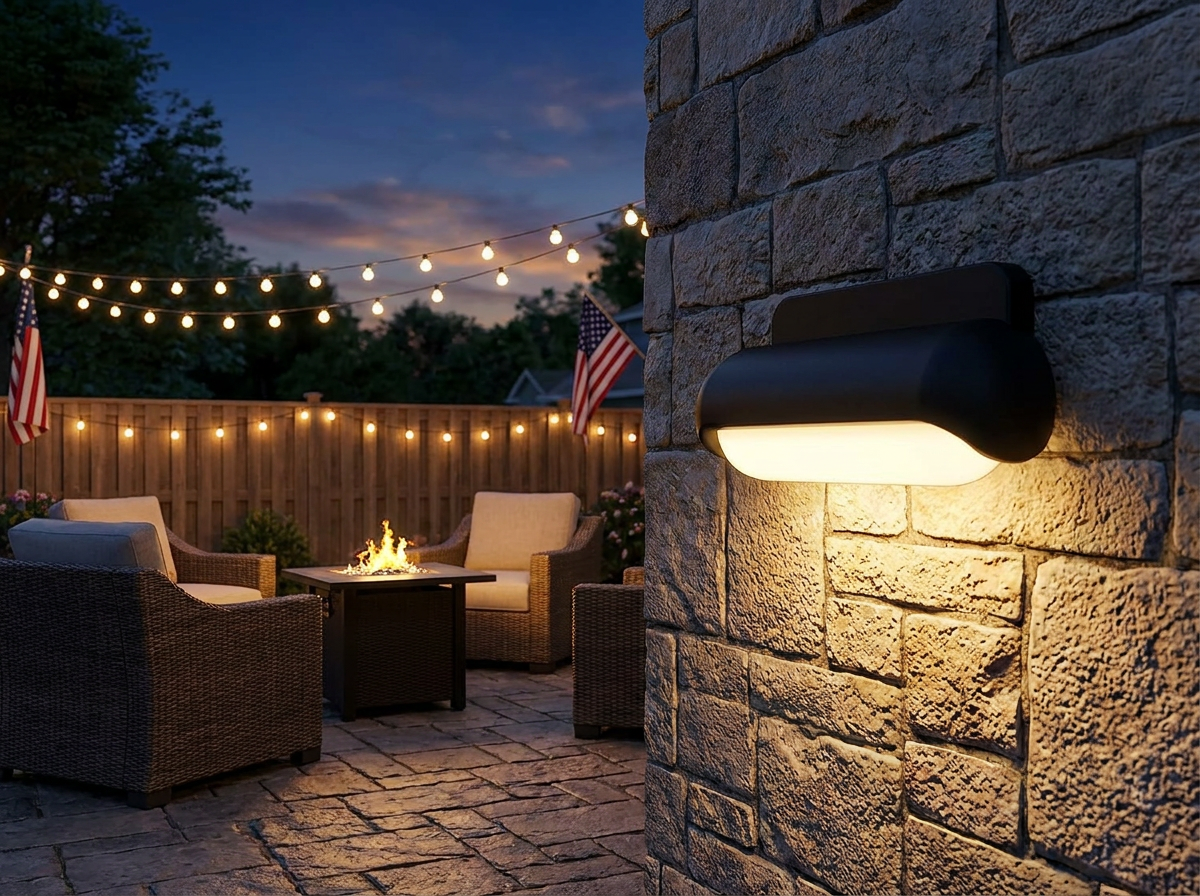
Sizing a wall sconce is where Pinterest dreams meet doorway reality. The American rule of thumb that has held up since at least the 2010s — and is doubly relevant in summer 2026 as oversized fixtures dominate Instagram feeds — is to mount the center of the sconce roughly at eye level plus six inches, which usually lands around 66 to 72 inches from the porch floor. Then size the fixture itself so that its overall height is about one-fourth to one-third of the door’s height. For a standard 80-inch front door, that means a sconce roughly 9 to 13 inches tall. The Modern Wall Sconce in this guide is purpose-sized for exactly this American-door geometry, so you skip the calculator and just hang it. If you’re upgrading a double-door entry, jump up one size or use a pair of fixtures flanking the doors — single tiny sconces look stranded against a wider entry.
7. Install Timeline: 90 Minutes on a Saturday, Hardwired
Hardwired modern wall sconces have a reputation for being intimidating, but in 2026 the reality is simpler. Kill the breaker, remove the old fixture, match the black-to-black and white-to-white wires, ground to ground, screw the new mounting plate to the existing junction box, snap the sconce on, restore power. For a swap on a porch you’ve already got a stepladder under, the whole job runs about 90 minutes start to finish — including the time to wipe down the siding around the old fixture footprint. If you’ve never done electrical work, hire it out for an hour of a licensed electrician’s time; on most American zip codes that’s $80 to $150 for a swap and worth every dollar before a holiday weekend. Either way, do not attempt the install with the breaker live. Independence Day is a fine reason to upgrade your porch light. It is not a fine reason to test your homeowners’ insurance.
8. Lifespan Math: Why “50,000-Hour LED” Is Not a Marketing Number
Run the math: 50,000 hours of rated LED life, divided by an average 10 hours of porch-light runtime per night, equals roughly 13.7 years. That is a fixture you install before this July 4th and don’t think about again until your kids are out of college. Compare that to the halogen porch bulb most American homes still rely on, which dies somewhere between 9 and 18 months and forces a ladder-and-replacement loop every fall and spring. Even setting aside the energy savings — and at 13W, the savings on a modern LED sconce running 10 hours a night work out to roughly $14 to $20 a year off the average US residential electric bill compared to a 60W halogen — the labor cost of not climbing a ladder twice a year is the real win. Lifespan math is what flips this from a $38 fixture into a multi-year curb-appeal investment.
9. Budget Logic: Why Sub-$40 Beats Sub-$20 for the Long Haul
The temptation in the summer 2026 home-improvement aisle is to grab the $14 builder-grade dome and call it done. Skip it. The fixtures in that price tier almost universally use a low-grade plastic housing that yellows in two American summers, an unsealed driver bay that fails after the first heavy October rain, and a non-replaceable LED chip that turns the whole unit into landfill the day it dims. The sweet spot for a long-term front-door wall sconce in 2026 sits in the $35 to $50 range — high enough to get a sealed aluminum housing, a tempered acrylic or glass diffuser, a quality LED driver, and a finish that survives sun and salt; low enough that you’re not paying boutique-brand markup. The PLUSLED Modern Wall Sconce lands directly in that zone at $37.99, with the spec sheet to back it up.
The 9-Point Checklist, Recapped Before You Click Buy
- 13W wattage — bright enough for the porch, soft enough for the door
- 3000K warm white — flattering on every American siding color
- IP44 minimum, IP65 ideal — survives summer 2026 storm season
- Universal US mounting plate — fits standard 4-inch junction boxes
- Matte black finish — the default modern American exterior color in 2026
- Properly sized to your door (about one-third of door height)
- Hardwired install, 90 minutes on a Saturday with breaker off
- 50,000-hour LED rated life — roughly 13 years of nightly use
- Budget in the $35–$50 sweet spot — quality without overpaying
If the fixture you’re shopping checks all nine of those boxes, you’re holding a winner — the kind of front-door upgrade that quietly lifts your curb appeal before the July 4th cookout, then keeps doing its job through Labor Day, fall foliage, the Thanksgiving driveway crowd, and well past the holiday lights. If it misses three or more, put it down and keep looking. Summer 2026 is not the year to settle for builder-grade.
Ready to Check All Nine Boxes in One Click?
The PLUSLED Modern Wall Sconce 13W 3000K — aluminum housing, IP-rated, universal US mount, matte black, eye-level sized for a standard American front door, and priced at the $37.99 sweet spot — was engineered against exactly the checklist above. Shop the PLUSLED Modern Wall Sconce today, swap it in before your July 4th cookout, and walk into Labor Day weekend with the porch finally looking like the rest of the house. Your delivery driver, your neighbors, and your home appraiser will all notice — even if no one says it out loud.
